


The Tropic of Cancer is an imaginary line of latitude located at approximately 23.44° north of the Equator. It marks the northernmost point on Earth where the Sun appears directly overhead at noon during the June solstice. This important latitude forms the northern boundary of the tropical zone and plays a key role in Earth’s climate, seasons, daylight patterns, and geography. In this guide, you’ll learn the definition of the Tropic of Cancer, its exact location, the countries it passes through, why it is important, and how it differs from the Tropic of Capricorn.
According to Encyclopaedia Britannica, the Tropic of Cancer is the northernmost latitude where the Sun can appear directly overhead during the June solstice.

What Is the Tropic of Cancer?
The Tropic of Cancer is an imaginary circle of latitude located at approximately 23.44° north of the Equator. It marks the northernmost point on Earth where the Sun can appear directly overhead at noon during the June solstice, which usually occurs on 20 or 21 June each year. This line also forms the northern boundary of the tropical region and helps define Earth’s climate zones and seasonal changes.
Tropic of Cancer Quick Facts
| Feature | Details |
|---|---|
| Latitude | Approximately 23.44° North (23°26′ N) |
| Type | Imaginary line of latitude |
| Location | Northern Hemisphere |
| Marks | The northern boundary of Earth's tropical zone |
| Sun Directly Overhead | During the June Solstice (around June 20–21) |
| Opposite Latitude | Tropic of Capricorn (23.44° South) |
| Purpose | Helps define Earth's climate zones, seasons, and daylight patterns |
| Crosses | 17 countries across North America, Africa, and Asia |
Where Is the Tropic of Cancer?
The Tropic of Cancer is located at approximately 23.44° north latitude (23°26′ N), making it one of the Earth’s five major circles of latitude. It stretches around the globe and passes through 17 countries across North America, Africa, and Asia, as well as several oceans and seas. This imaginary line marks the northern limit of the tropical zone, meaning locations south of it experience the Sun directly overhead at least once each year.
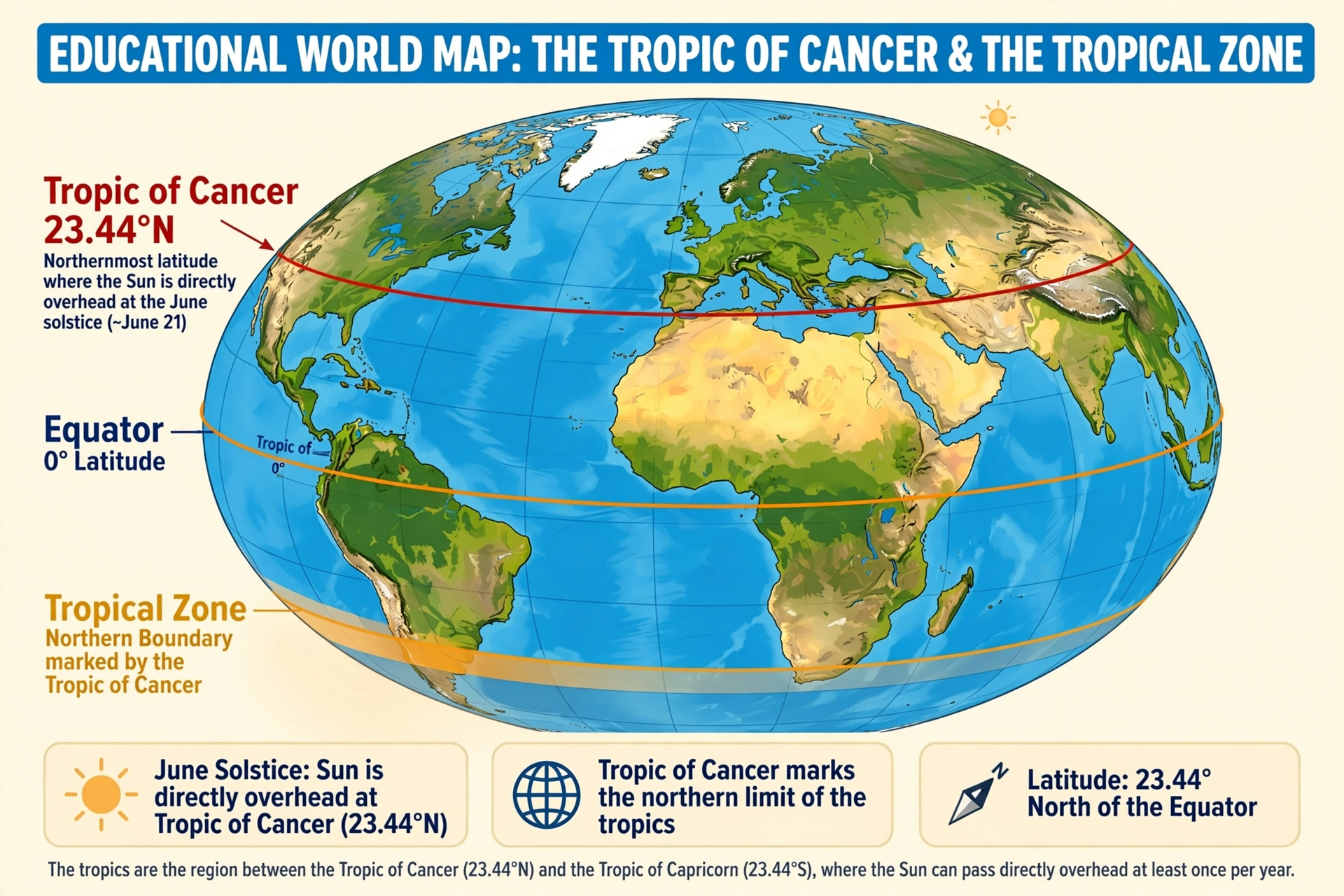
Countries the Tropic of Cancer Passes Through
| Continent | Countries |
|---|---|
| North America | Mexico, Bahamas* |
| Africa | Western Sahara, Mauritania, Mali, Algeria, Niger, Libya, Egypt |
| Asia | Saudi Arabia, United Arab Emirates, Oman, India, Bangladesh, Myanmar, China, Taiwan |
*The Tropic of Cancer crosses the Bahamian archipelago rather than a single island.
Why Is the Tropic of Cancer Important?
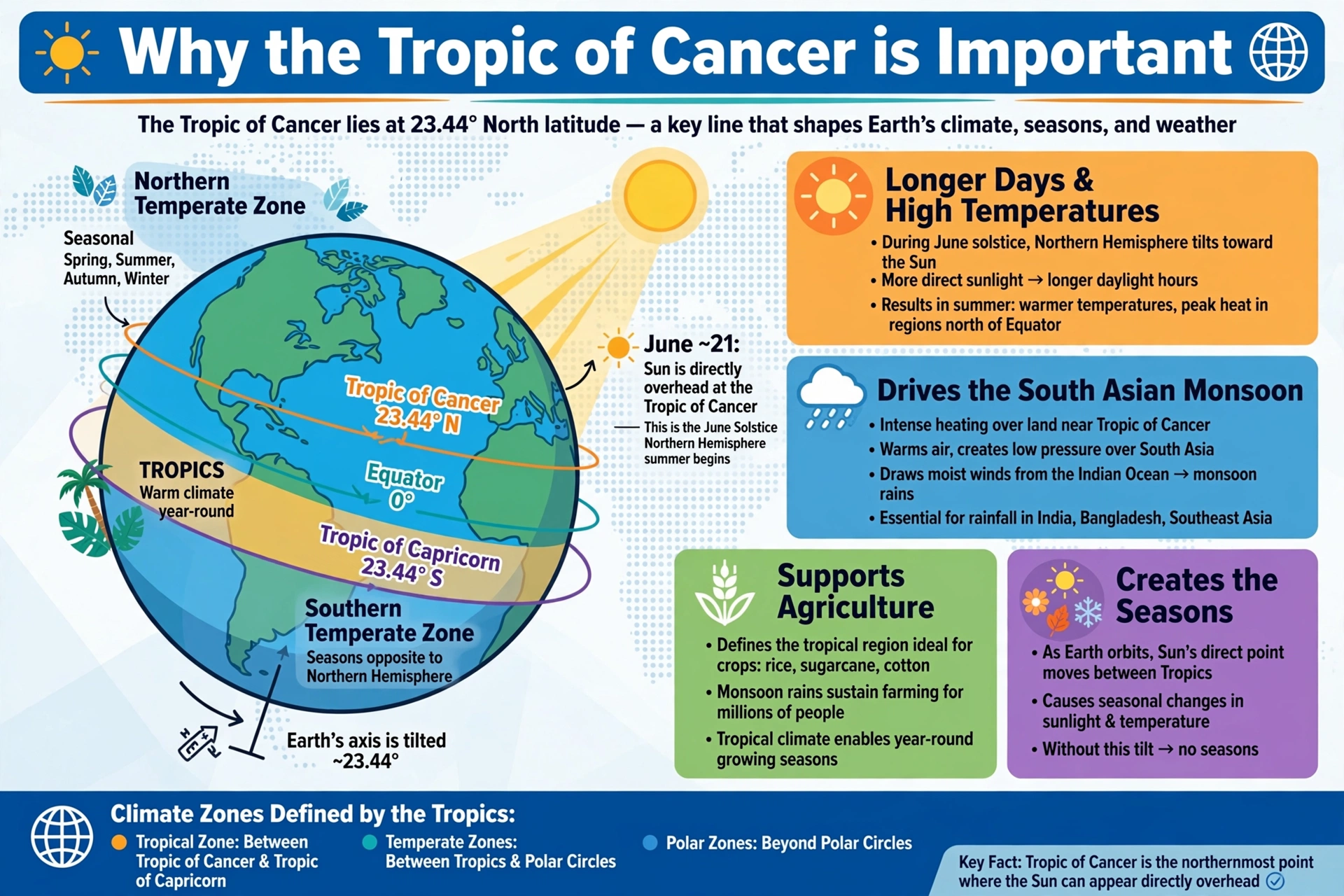
The Tropic of Cancer is important because it marks the northernmost latitude where the Sun can appear directly overhead at noon. This occurs during the June solstice, when the Northern Hemisphere is tilted toward the Sun. As a result, regions near the Tropic of Cancer receive the most direct sunlight of the year, leading to longer days, higher temperatures, and the beginning of summer in the Northern Hemisphere.
The Tropic of Cancer also plays a vital role in geography, climate, and meteorology. Together with the Equator and the Tropic of Capricorn, it helps divide Earth into major climate zones. These zones influence temperature patterns, rainfall, ecosystems, agriculture, and seasonal weather across different parts of the world.
For countries located on or near the Tropic of Cancer, the increased solar heating contributes to regional weather systems. In South Asia, for example, this seasonal warming helps drive the atmospheric circulation that supports the summer monsoon, bringing much of the rainfall needed for agriculture and freshwater supplies.
Beyond climate, the Tropic of Cancer serves as an important geographical reference line used in education, navigation, mapping, and scientific research. It helps explain why different parts of the Earth experience varying daylight hours, seasons, and temperatures throughout the year.
Did You Know?
Although the Tropic of Cancer is commonly described as being at 23.5° north latitude, its exact position slowly changes over time because Earth’s axial tilt is not constant. Today, it lies at approximately 23.44° north.
Tropic of Cancer Latitude
The Tropic of Cancer is located at approximately 23.44° north latitude (23°26′ N). This imaginary circle of latitude marks the northernmost point where the Sun can appear directly overhead at noon during the June solstice, which usually occurs on 20 or 21 June each year.
Although many textbooks still refer to the Tropic of Cancer as 23.5° north latitude, the exact position changes slowly over time. This is because Earth’s axial tilt gradually shifts due to natural astronomical movements, causing the latitude of the Tropic of Cancer to move slightly southward over thousands of years.
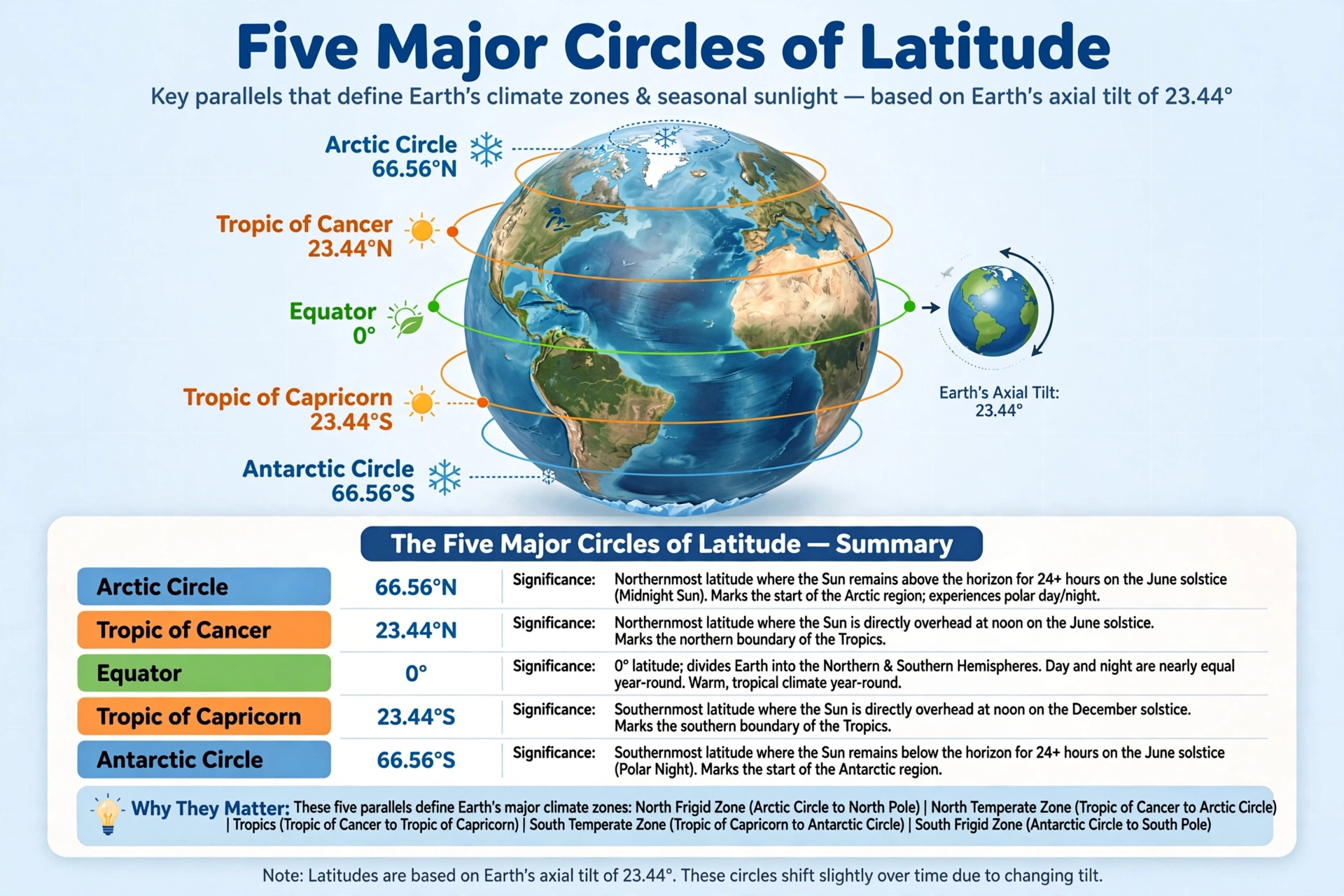
The Tropic of Cancer is one of the five major circles of latitude used to divide Earth into important geographical zones. The other four are the Equator, Tropic of Capricorn, Arctic Circle, and Antarctic Circle. Together, these lines help scientists, geographers, and navigators describe locations, climate regions, and seasonal changes across the planet.
The Five Major Circles of Latitude
| Circle of Latitude | Approximate Latitude | Significance |
|---|---|---|
| Arctic Circle | 66.56° N | Marks the southern boundary of the Arctic region and experiences at least one day of 24-hour daylight and one day of 24-hour darkness each year. |
| Tropic of Cancer | 23.44° N | Marks the northern boundary of the tropics and the northernmost point where the Sun can appear directly overhead during the June solstice. |
| Equator | 0° | Divides Earth into the Northern and Southern Hemispheres and receives nearly equal daylight throughout the year. |
| Tropic of Capricorn | 23.44° S | Marks the southern boundary of the tropics and the southernmost point where the Sun can appear directly overhead during the December solstice. |
| Antarctic Circle | 66.56° S | Marks the northern boundary of the Antarctic region and experiences at least one day of 24-hour daylight and one day of 24-hour darkness each year. |
Why Is It Called the Tropic of Cancer?
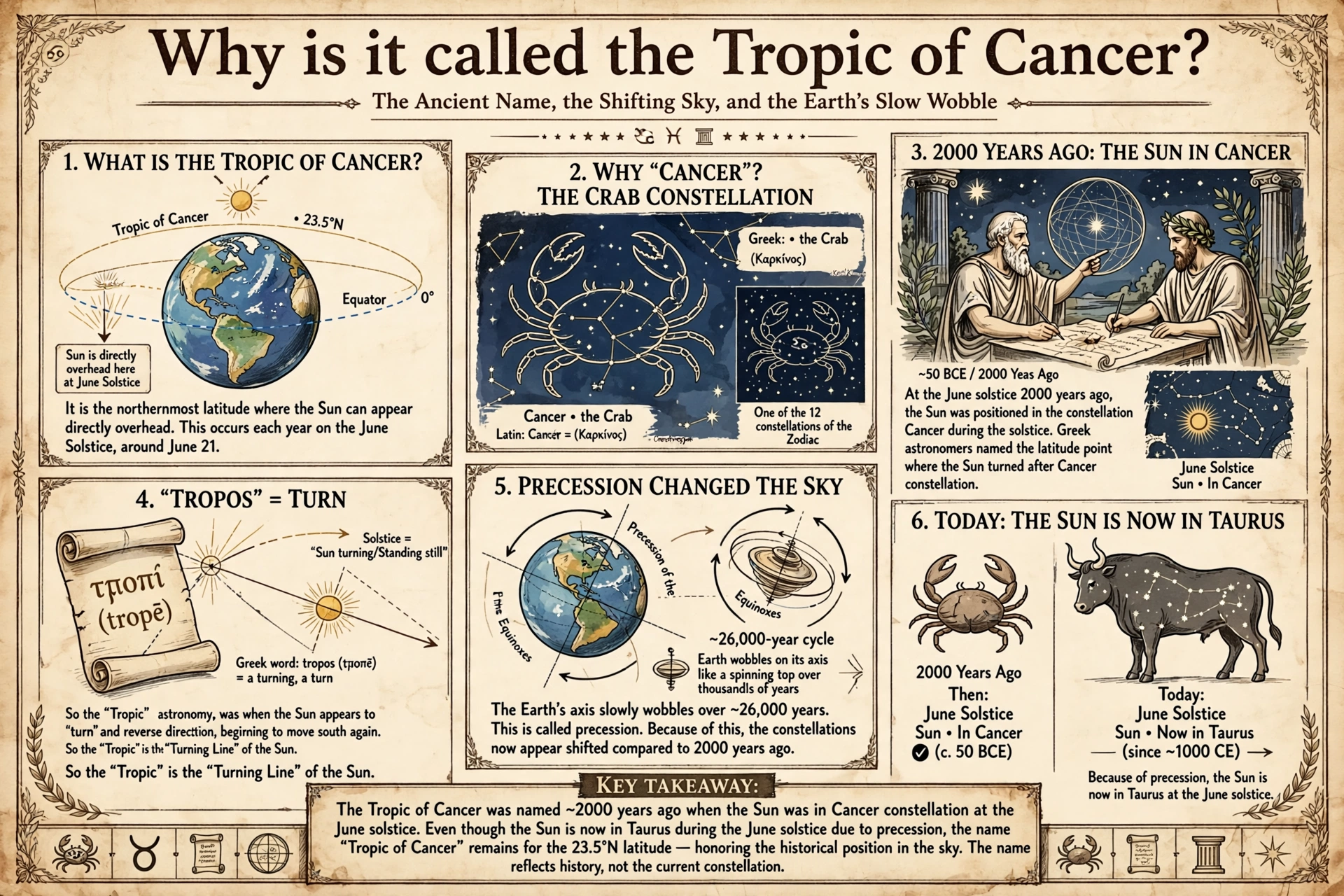
The Tropic of Cancer gets its name from the constellation Cancer, not from the disease. More than 2,000 years ago, when ancient Greek astronomers named this line of latitude, the Sun appeared in the constellation Cancer during the June solstice. As a result, the northern tropical boundary became known as the Tropic of Cancer.
Due to a gradual astronomical phenomenon known as the precession of Earth’s axis, the Sun no longer appears in the constellation Cancer during the June solstice. Today, it is positioned in the constellation Taurus at that time of year. However, the original name has been preserved for historical and geographical reasons.
The word “tropic” comes from the ancient Greek word tropos, meaning “turn” or “to change direction.” It refers to the point in the Sun’s apparent annual journey where it appears to reverse direction after reaching its northernmost or southernmost position in the sky. This change marks the beginning of a new seasonal cycle.
Although the astronomical position of the Sun has changed over the centuries, the names Tropic of Cancer and Tropic of Capricorn remain internationally recognised geographical terms used in maps, education, navigation, and climate studies.
💡 Did You Know?
The Tropic of Cancer was named more than 2,000 years ago. Because Earth’s axis slowly wobbles over time, the Sun is no longer in the constellation Cancer during the June solstice, but the name has remained unchanged.
How the Tropic of Cancer Affects Climate and Seasons
The Tropic of Cancer plays a significant role in shaping Earth’s climate and seasonal weather patterns. During the June solstice, the Northern Hemisphere is tilted toward the Sun, allowing areas near the Tropic of Cancer to receive the most direct sunlight of the year. This results in longer daylight hours, higher temperatures, and the official beginning of summer in the Northern Hemisphere.
As the Sun’s direct rays move north and south throughout the year, the amount of solar energy reaching different parts of Earth changes. This movement creates the changing seasons and influences temperature, rainfall, and weather patterns across the globe. Regions located close to the Tropic of Cancer generally experience warm climates, although local weather also depends on factors such as altitude, ocean currents, and rainfall.
Because of its influence on solar radiation and climate, the Tropic of Cancer is an important geographical reference used by meteorologists, climatologists, and environmental scientists to study weather systems, ecosystems, and long-term climate patterns. Understanding how solar energy is distributed across the Earth’s surface also helps explain broader environmental challenges, including changing weather patterns and rising global temperatures. If you’d like to learn more, read our guide on Global Warming and Its Impact, which explores how climate change is affecting ecosystems, sea levels, and weather worldwide.
The seasonal heating around the Tropic of Cancer also contributes to major atmospheric circulation patterns. In South Asia, for example, the intense summer heating helps create low-pressure systems that draw moisture-laden winds inland, supporting the South Asian monsoon. These seasonal rains are essential for agriculture, freshwater resources, and millions of people living across the region.
Because of its influence on solar radiation and climate, the Tropic of Cancer is an important geographical reference used by meteorologists, climatologists, and environmental scientists to study weather systems, ecosystems, and long-term climate patterns.
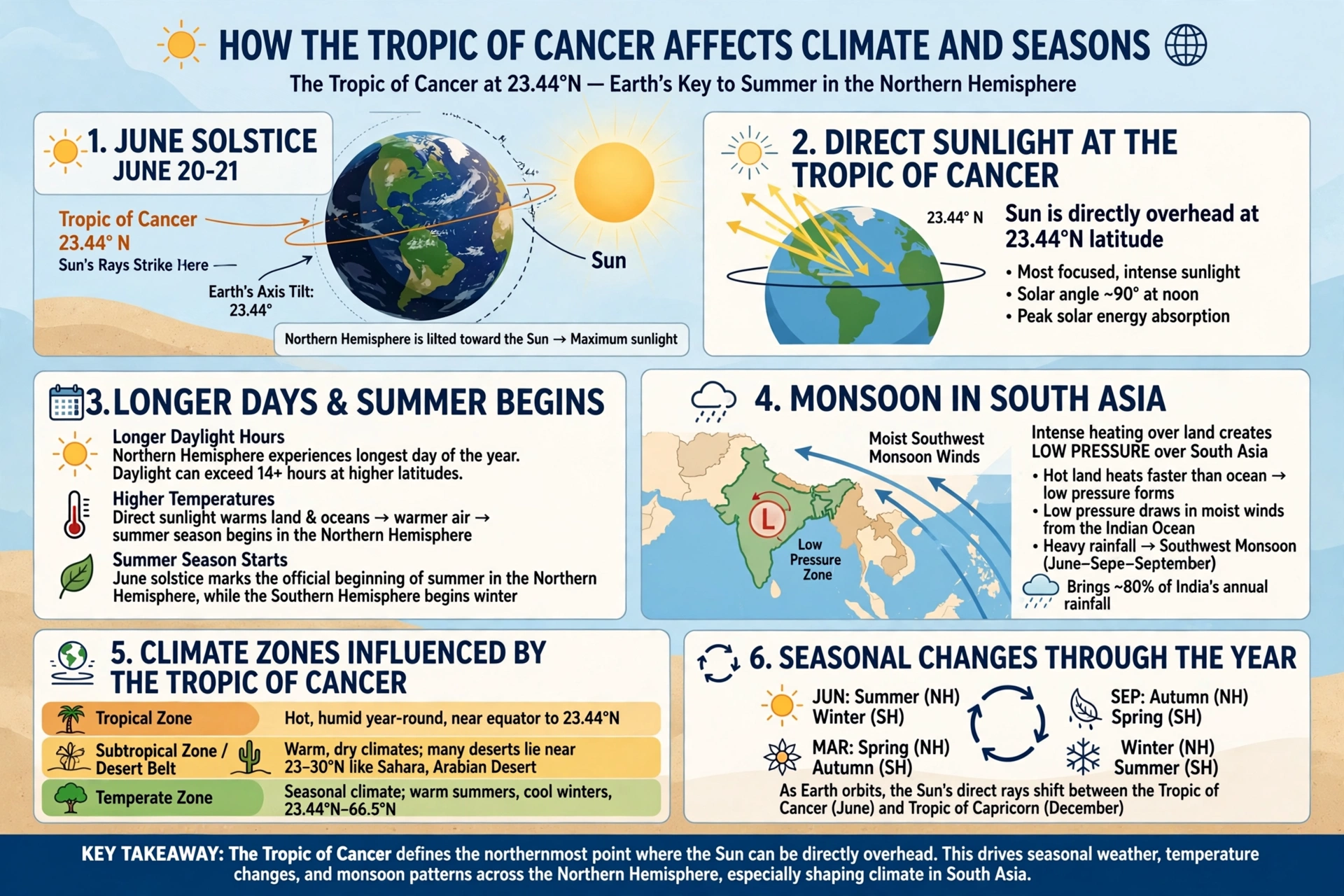
Earth’s changing seasons are caused by the tilt of its axis rather than its distance from the Sun. NASA explains how Earth’s axial tilt and the seasons influence daylight and solar energy.
Tropic of Cancer vs. Tropic of Capricorn
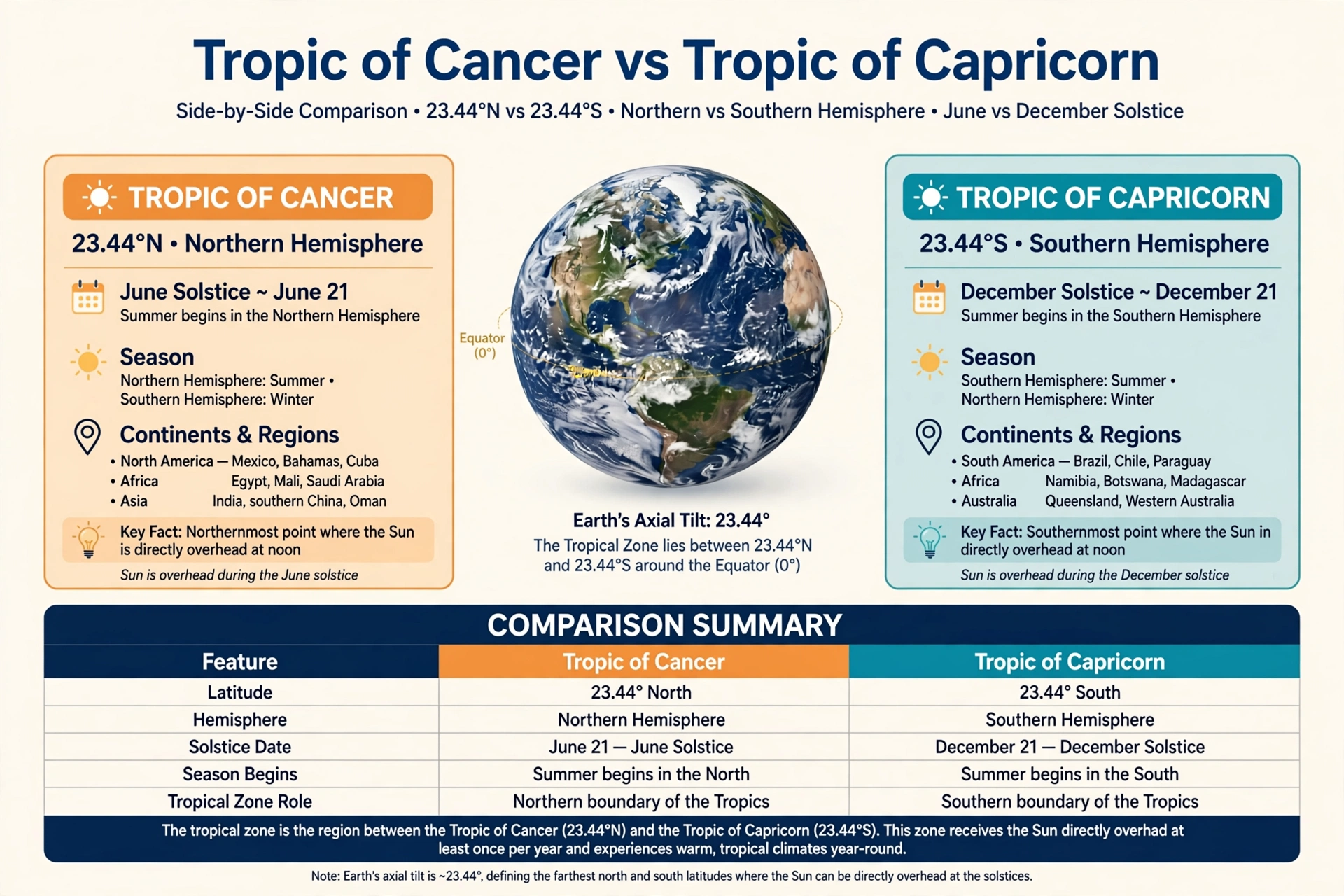
The Tropic of Cancer and the Tropic of Capricorn are the two most important lines of latitude that define Earth’s tropical region. Both are located approximately 23.44° from the Equator, but they lie in opposite hemispheres and mark the farthest points where the Sun can appear directly overhead at noon during the solstices.
The Tropic of Cancer is located in the Northern Hemisphere and receives the Sun’s direct rays during the June solstice, while the Tropic of Capricorn is located in the Southern Hemisphere and receives direct sunlight during the December solstice. Together, these two imaginary lines help explain Earth’s seasons, climate zones, and the changing length of daylight throughout the year.
| Feature | Tropic of Cancer | Tropic of Capricorn |
|---|---|---|
| Latitude | 23.44° North | 23.44° South |
| Hemisphere | Northern Hemisphere | Southern Hemisphere |
| Sun Directly Overhead | June Solstice | December Solstice |
| Season Begins | Summer (Northern Hemisphere) | Summer (Southern Hemisphere) |
| Marks | Northern boundary of the tropics | Southern boundary of the tropics |
| Primary Continents | North America, Africa, Asia | South America, Africa, Australia |
| Purpose | Defines the northern tropical limit | Defines the southern tropical limit |
Key Differences at a Glance
Although both lines are equally important in geography, they affect different parts of the world at different times of the year.
- The Tropic of Cancer lies north of the Equator, while the Tropic of Capricorn lies south of it.
- The Sun is directly overhead at the Tropic of Cancer during the June solstice, but over the Tropic of Capricorn during the December solstice.
- The Tropic of Cancer marks the beginning of summer in the Northern Hemisphere, whereas the Tropic of Capricorn marks the beginning of summer in the Southern Hemisphere.
- Together, these two latitudes define the boundaries of Earth’s tropical zone and help explain seasonal changes around the globe.
Areas between the Tropic of Cancer and the Tropic of Capricorn are known as the tropics, a region characterised by warm temperatures and diverse ecosystems.
Interesting Facts About the Tropic of Cancer
The Tropic of Cancer is one of Earth’s most important lines of latitude, but there are many fascinating facts about it that most people don’t know. From its changing position to the countries it crosses, this imaginary line has played an important role in geography, astronomy, and navigation for thousands of years.
10 Interesting Facts About the Tropic of Cancer
1. It Is an Imaginary Line
The Tropic of Cancer is not a physical line that can be seen on the ground. It is an imaginary circle of latitude used by geographers, scientists, and mapmakers to divide the Earth into climate zones.
2. It Lies at Approximately 23.44° North
The Tropic of Cancer is located at approximately 23.44° north of the Equator. Although many books round this to 23.5° N, the exact latitude changes slightly over time because of Earth’s changing axial tilt.
3. The Sun Is Directly Overhead Only Once Each Year
During the June solstice, usually on 20 or 21 June, the Sun appears directly overhead at noon for places located on the Tropic of Cancer. This is the northernmost point where this phenomenon occurs.
4. It Marks the Northern Boundary of the Tropics
The Tropic of Cancer forms the northern limit of Earth’s tropical zone. Areas between the Tropic of Cancer and the Tropic of Capricorn receive the Sun directly overhead at least once each year.
5. It Crosses 17 Countries
The Tropic of Cancer passes through 17 countries across North America, Africa, and Asia, making it one of the world’s most significant geographical reference lines.
6. Its Name Comes from the Constellation Cancer
The line was named more than 2,000 years ago because the Sun appeared in the constellation Cancer during the June solstice. Due to the slow movement of Earth’s axis, the Sun is now in the constellation Taurus during the June solstice, but the original name has remained.
7. It Helps Define Earth’s Seasons
Together with the Equator and the Tropic of Capricorn, the Tropic of Cancer helps explain why different parts of Earth experience changing seasons, daylight hours, and temperatures throughout the year.
8. It Influences Climate Patterns
The increased solar heating near the Tropic of Cancer contributes to atmospheric circulation and weather systems. In parts of Asia, this seasonal heating plays a role in the development of the summer monsoon.
9. Several Famous Landmarks Mark the Tropic of Cancer
Many countries have installed monuments and roadside markers where the Tropic of Cancer passes. These landmarks are popular tourist attractions and educational sites for visitors interested in geography and astronomy.
10. The Tropic of Cancer Slowly Moves
The position of the Tropic of Cancer is not fixed forever. It gradually shifts because Earth’s axial tilt changes over long periods, causing the latitude to move by a small amount over thousands of years.
Frequently Asked Questions
The Tropic of Cancer is an imaginary line of latitude located at approximately 23.44° north of the Equator. It marks the northernmost point where the Sun appears directly overhead at noon during the June solstice.
The Tropic of Cancer circles the Earth at approximately 23.44° north latitude. It passes through 17 countries across North America, Africa, and Asia, including Mexico, Egypt, Saudi Arabia, India, Bangladesh, Myanmar, and China.
The Tropic of Cancer is currently located at approximately 23.44° north latitude (23°26′ N). Its exact position changes very slowly over time because of gradual changes in Earth's axial tilt.
The Tropic of Cancer was named more than 2,000 years ago because the Sun appeared in the constellation Cancer during the June solstice. Due to Earth's axial precession, the Sun now appears in Taurus during the June solstice, but the historical name remains unchanged.
The Tropic of Cancer marks the northern boundary of Earth's tropical zone. It helps explain seasons, climate zones, daylight hours, and the movement of the Sun's direct rays throughout the year.
The Tropic of Cancer is located north of the Equator at approximately 23.44° north latitude. It marks the northern boundary of the tropical region.
Yes. The Tropic of Cancer passes through eight Indian states: Gujarat, Rajasthan, Madhya Pradesh, Chhattisgarh, Jharkhand, West Bengal, Tripura, and Mizoram.
No. The Tropic of Cancer does not pass through Pakistan. It lies south of Pakistan and passes through neighbouring India.
Regions near the Tropic of Cancer are generally warm to hot because they receive strong sunlight, especially during the June solstice. However, local temperatures also depend on factors such as altitude, rainfall, and proximity to oceans.
Conclusion
The Tropic of Cancer is much more than an imaginary line on a map. It marks the northern boundary of Earth’s tropical region and plays a crucial role in understanding the planet’s geography, climate, and changing seasons. Every year during the June solstice, the Sun appears directly overhead at this latitude, influencing daylight hours, temperatures, and weather patterns across the Northern Hemisphere.
Whether you’re studying geography, preparing for an exam, or simply curious about how Earth works, understanding the Tropic of Cancer helps explain why different parts of the world experience varying climates and seasons. Together with the Equator and the Tropic of Capricorn, it remains one of the most important reference lines used in science, navigation, and education.
If you’re interested in learning more about Earth’s atmosphere and environmental challenges, explore our related guides on Air Pollution.



I indeed like this advise, i did not appreciate a destiny of the things that you posted in here. i have much more latest information with regard to these topics and topics coordinated to it. some people may find it implacable to understand the English language but i upon it moderately gentle for the retreat that has discover to be what is today policy.