

Have you ever watched one video on YouTube and then noticed that the platform seems to know exactly what you want to watch next? Whether it is another video from the same creator, a related topic, or something completely different that matches your interests, these recommendations are powered by the YouTube algorithm.
YouTube uses a sophisticated recommendation system to personalize the videos shown to each viewer. It considers signals such as what people watch, what they search for, which videos they choose, and how satisfied they are with their viewing experience. The goal is not simply to show the most popular videos, but to help each person discover videos that are relevant and useful to them.
For creators, understanding the YouTube algorithm can be equally important. Getting a video recommended can help it reach viewers beyond the creator’s existing subscribers and potentially increase views, watch time, and audience growth. However, there is no single trick that guarantees success. YouTube’s recommendation system has evolved significantly since the platform launched, and its approach today is much more sophisticated than simply counting views or clicks.
So, how does the YouTube algorithm actually work? And what determines which video appears on your screen next? Let’s explore how YouTube’s recommendation system evolved, what signals influence recommendations, and what creators should understand about the algorithm today.
What Is the YouTube Algorithm?
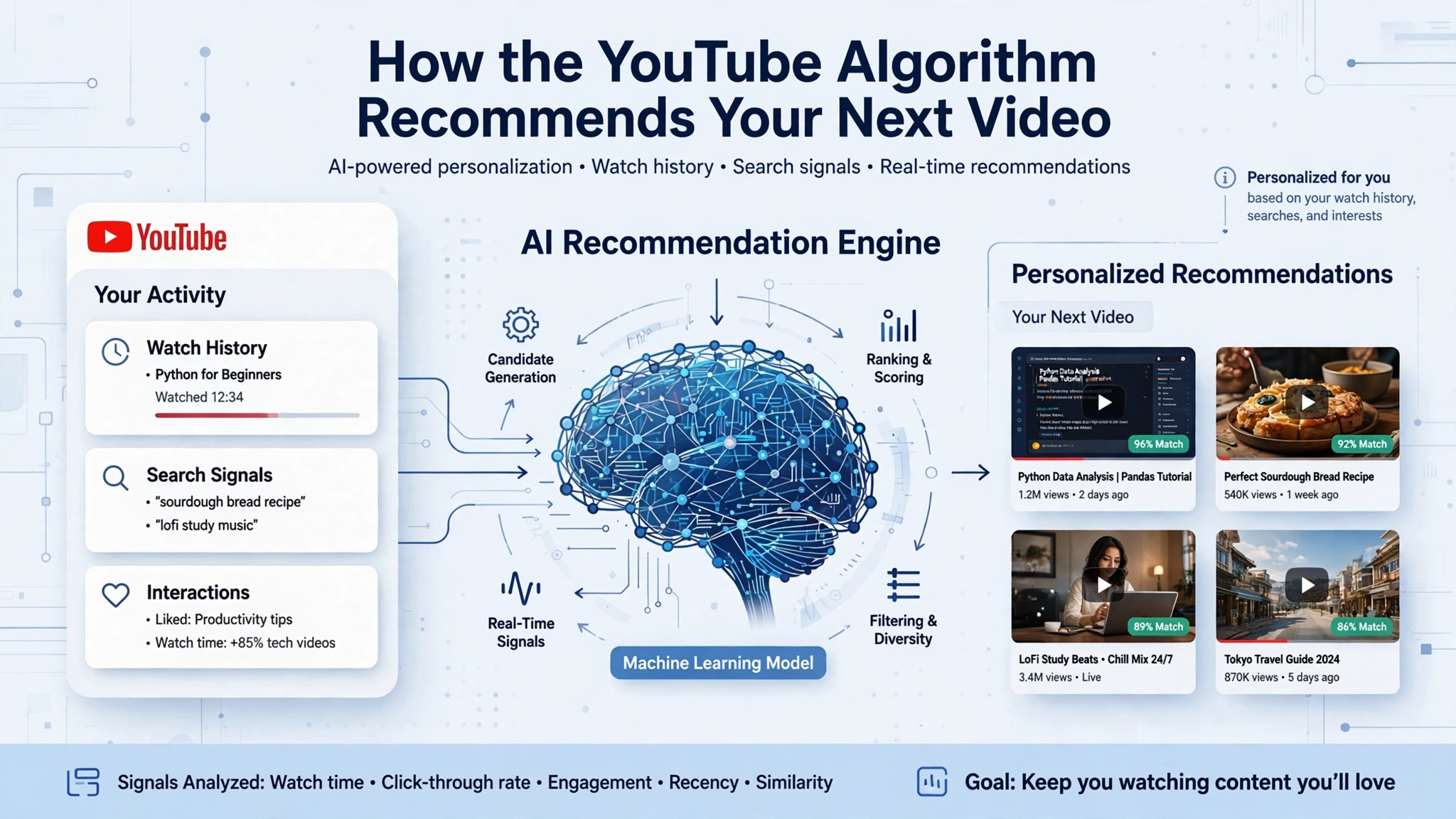
The YouTube algorithm is the system that helps determine which videos are shown to viewers and where those videos appear across YouTube. Rather than using one simple formula, YouTube uses recommendation systems that process different signals to personalize the viewing experience for each person.
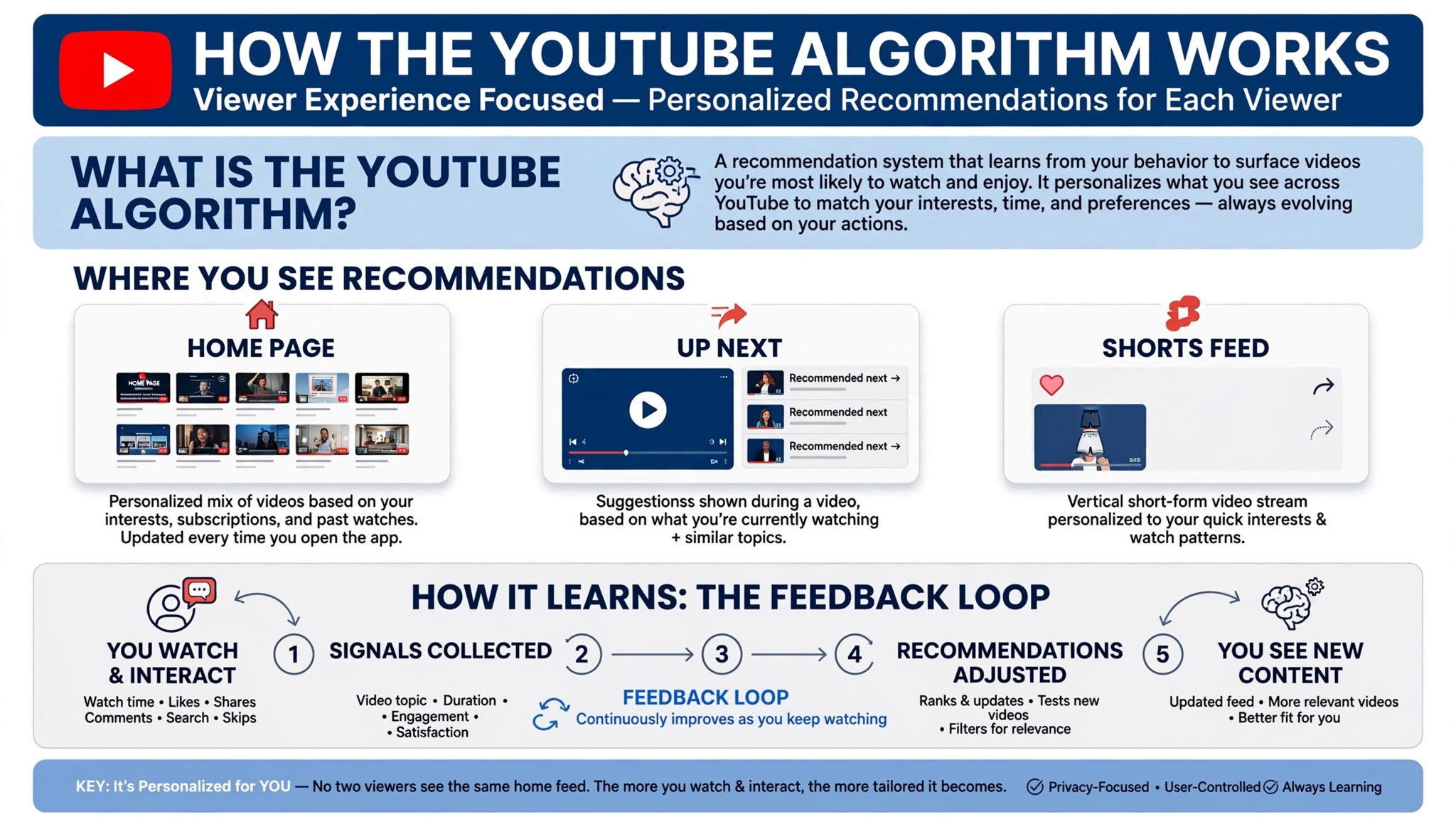
YouTube’s recommendations can appear in several places, including the Home page, Up Next section, and Shorts feed. Learn how YouTube recommendations work.The videos a viewer sees can be different from those shown to another person because recommendations are influenced by individual viewing behavior and interests.
For example, if you regularly watch technology reviews, YouTube may recommend more videos about smartphones, computers, software, or other technology topics. If you start watching cooking videos, the recommendations can gradually change to reflect that new interest.
This means the YouTube algorithm is not simply asking, “Which video is the most popular?” Instead, the recommendation system attempts to determine which video is most relevant to a particular viewer at a particular time.
For creators, this distinction is important. A video does not necessarily need to be the biggest or most-viewed video on YouTube to receive recommendations. Its ability to attract and satisfy the right audience can also influence whether YouTube continues showing it to viewers who may be interested in that content.
The Algorithm Is Designed Around Viewers
One of the most important things to understand is that YouTube’s recommendation system is primarily designed around the viewer experience.
When someone watches, skips, searches for, or interacts with videos, these actions provide signals that can help YouTube understand what that person may want to see next. The system can then use those signals to personalize future recommendations.
How YouTube Learns From Your Viewing
Watch
You watch a video or interact with content.
Signals
YouTube receives signals from your activity.
Recommend
The system selects videos that may interest you.
Respond
You watch, skip, or interact with another video.
Learn
New signals help personalize future recommendations.
Youtube viewer interests can change over time, recommendations can change as well. Someone who watches gaming videos today may receive very different recommendations after spending several weeks watching educational, travel, music, or fitness content.
That is why there is no single universal list of videos that the YouTube algorithm recommends to everyone. YouTube recommendations are personalized to individual viewers and their changing interests.
How the YouTube Algorithm Works
The YouTube algorithm does not rely on a single factor to decide which video a viewer should see next. Instead, YouTube uses recommendation systems that consider multiple signals to understand what content may be relevant to an individual viewer.
These signals can come from the viewer’s activity, the videos themselves, and the way viewers respond to recommended content. The system then uses this information to personalize recommendations and continually adjust what appears in front of each viewer.
It Starts With Your Viewing Behavior
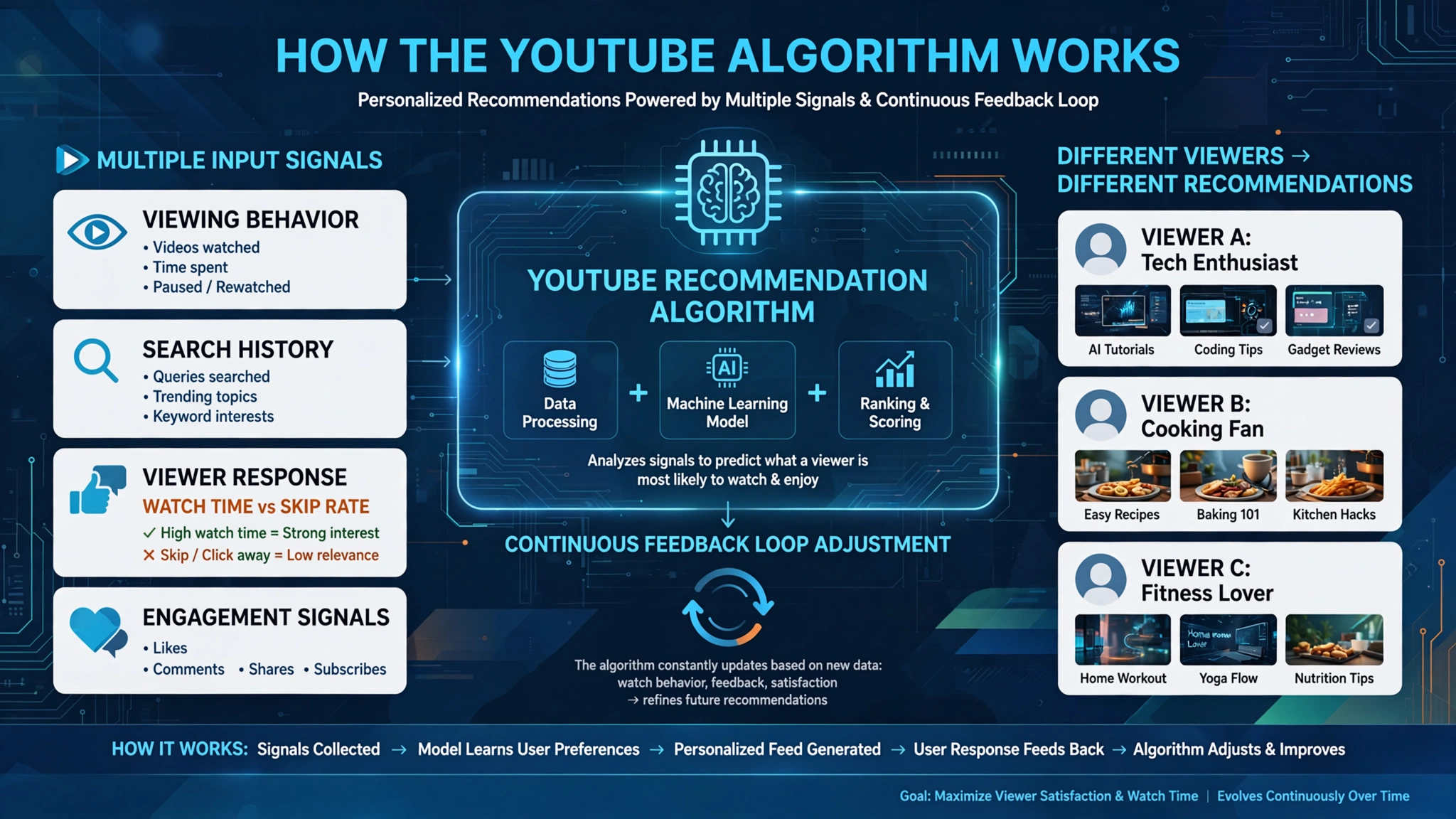
Your activity on YouTube provides important signals about your interests. The videos you watch, the searches you make, and the content you choose to interact with can help YouTube understand what topics and types of videos may be relevant to you.
For example, someone who frequently watches programming tutorials may receive more videos about coding, software development, and related technologies. Another viewer who spends more time watching travel content may see recommendations focused on destinations, travel guides, and related experiences.
These recommendations can change as your viewing behavior changes.
YouTube Considers How Viewers Respond
The algorithm also looks at how people respond to videos that are recommended to them. Choosing to watch a video provides a different signal from immediately skipping it, while continuing to watch can provide additional information about whether the content was useful or interesting to that viewer.
This is one reason why simply getting a video shown to a large number of people does not automatically mean that it will continue receiving recommendations. What happens after the recommendation is also important.
Different Viewers Can See Different Recommendations
There is no single recommendation list that is identical for everyone. Two people searching for or watching similar content can still receive different recommendations because their previous viewing behavior and interests may be different.
The system therefore attempts to match the right content with the right viewer, rather than simply promoting the videos with the highest overall number of views.
Recommendations Are Continuously Adjusted
The process does not stop after YouTube recommends a video. A viewer’s next action provides additional information that can influence future recommendations.
If a viewer consistently chooses certain types of videos, the system can use those signals to provide more relevant content. If their interests change, their recommendations can change as well.
This creates an ongoing feedback loop in which viewer behavior helps shape future recommendations.
The YouTube algorithm is constantly trying to answer one question: what video is this particular viewer most likely to find valuable or interesting right now?
How the YouTube Algorithm Has Changed
The YouTube algorithm has changed significantly since the platform launched. What worked in YouTube’s early years is very different from the recommendation system viewers experience today.
Understanding this history helps explain why views, clicks, watch time, and viewer satisfaction have all played different roles in YouTube’s recommendation approach over time.
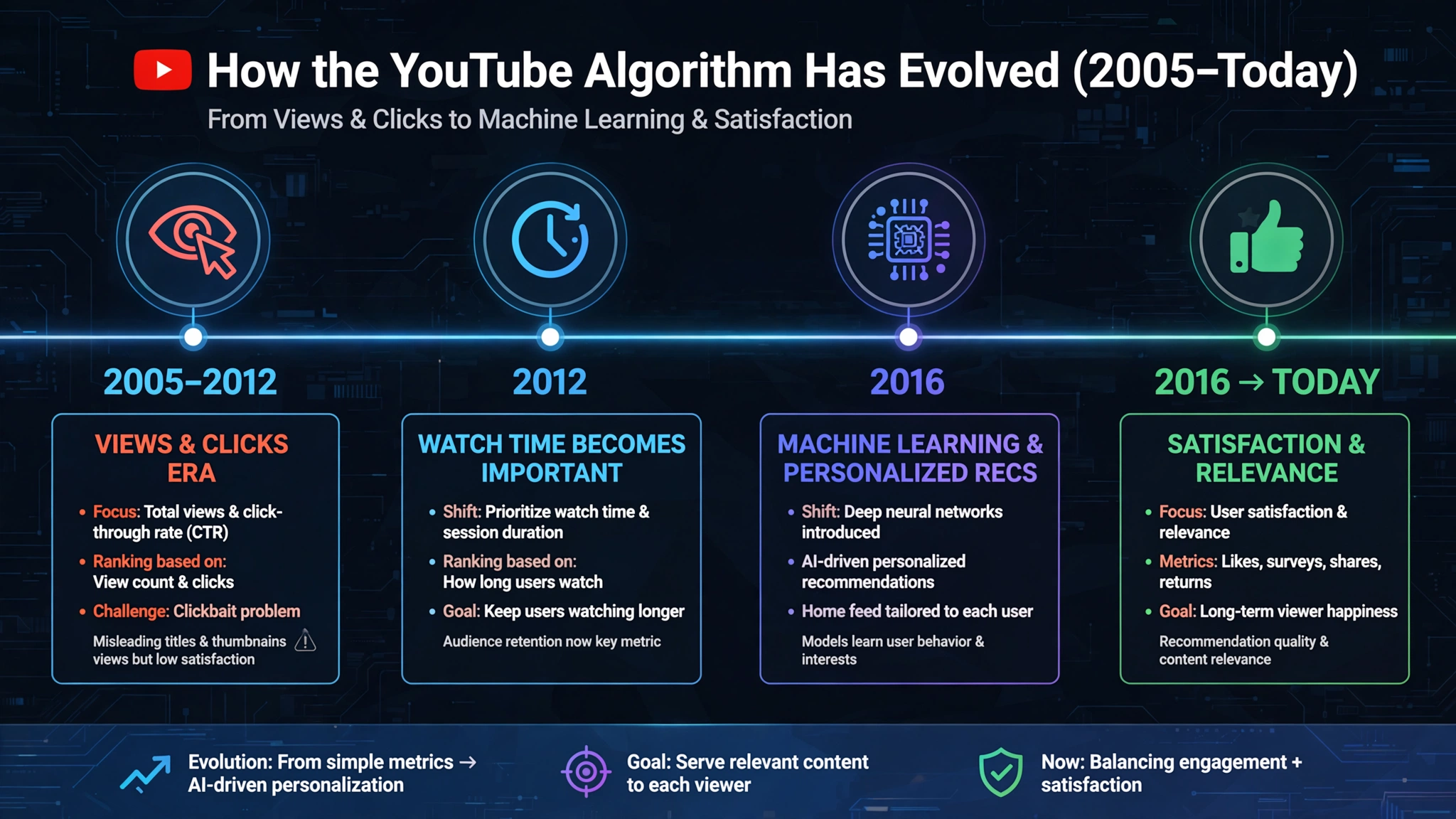
2005–2012: Views and Clicks
In YouTube’s early years, views and clicks were important indicators of a video’s popularity. Videos that attracted a large number of clicks and views could gain greater visibility on the platform.
This approach created an opportunity for creators to attract attention with eye-catching titles and thumbnails. However, it also created a problem: a click did not necessarily mean that a viewer was satisfied with what they watched.
Some creators began using clickbait titles and misleading thumbnails to generate more clicks. A video could attract a large number of viewers without actually providing the experience those viewers expected.
This highlighted an important weakness in using clicks and views as the primary indicators of successful content.
2012: Watch Time Became More Important
In 2012, YouTube changed its approach by placing greater emphasis on watch time.
Instead of simply asking how many people clicked on a video, the platform could also consider how much time viewers spent watching content. This provided a better indication of whether people were actually staying with the video after clicking on it.
The change also affected content creators. Rather than focusing only on attracting clicks, creators had a stronger reason to produce videos that kept viewers watching.
However, watch time alone could not completely explain whether a video was a good recommendation for a particular person. A longer video could generate more watch time without necessarily being more useful or satisfying to every viewer.
2016: Machine Learning and Personalized Recommendations
YouTube’s recommendation system became increasingly sophisticated as the platform adopted machine learning and deep neural networks.
This broader development reflects how artificial intelligence technology has increasingly influenced the way modern digital platforms process information and personalize experiences.
A research paper published by YouTube researchers described a recommendation system based on deep neural networks that could help generate and rank candidate videos for individual users.
YouTube’s recommendation research has also explored deep learning at large scale. The 2016 research paper, Deep Neural Networks for YouTube Recommendations , describes the use of deep learning for candidate generation and ranking.
This represented a major shift from simply looking at broad popularity. Machine learning made it possible to process large amounts of information and identify patterns in viewing behavior at a much greater scale.
The recommendation system could therefore become more personalized, helping different viewers receive different video suggestions based on their interests and behavior.
From 2016 to Today
YouTube’s recommendation systems have continued to evolve rather than remaining tied to one fixed ranking formula.
The platform has increasingly focused on providing viewers with content that is relevant and satisfying, while also taking steps to reduce the recommendation of problematic or borderline content.
This evolution is important because it shows why there is no single trick that completely explains the YouTube algorithm.
The system has moved from relatively simple popularity signals toward increasingly personalized recommendation systems that can evaluate many different signals and adapt to individual viewers.
Today, the central idea is much broader than simply getting the most clicks or accumulating the highest number of views.
YouTube's recommendation systems are designed to help viewers discover videos they are likely to find relevant and satisfying.
Where Does YouTube Recommend Videos?
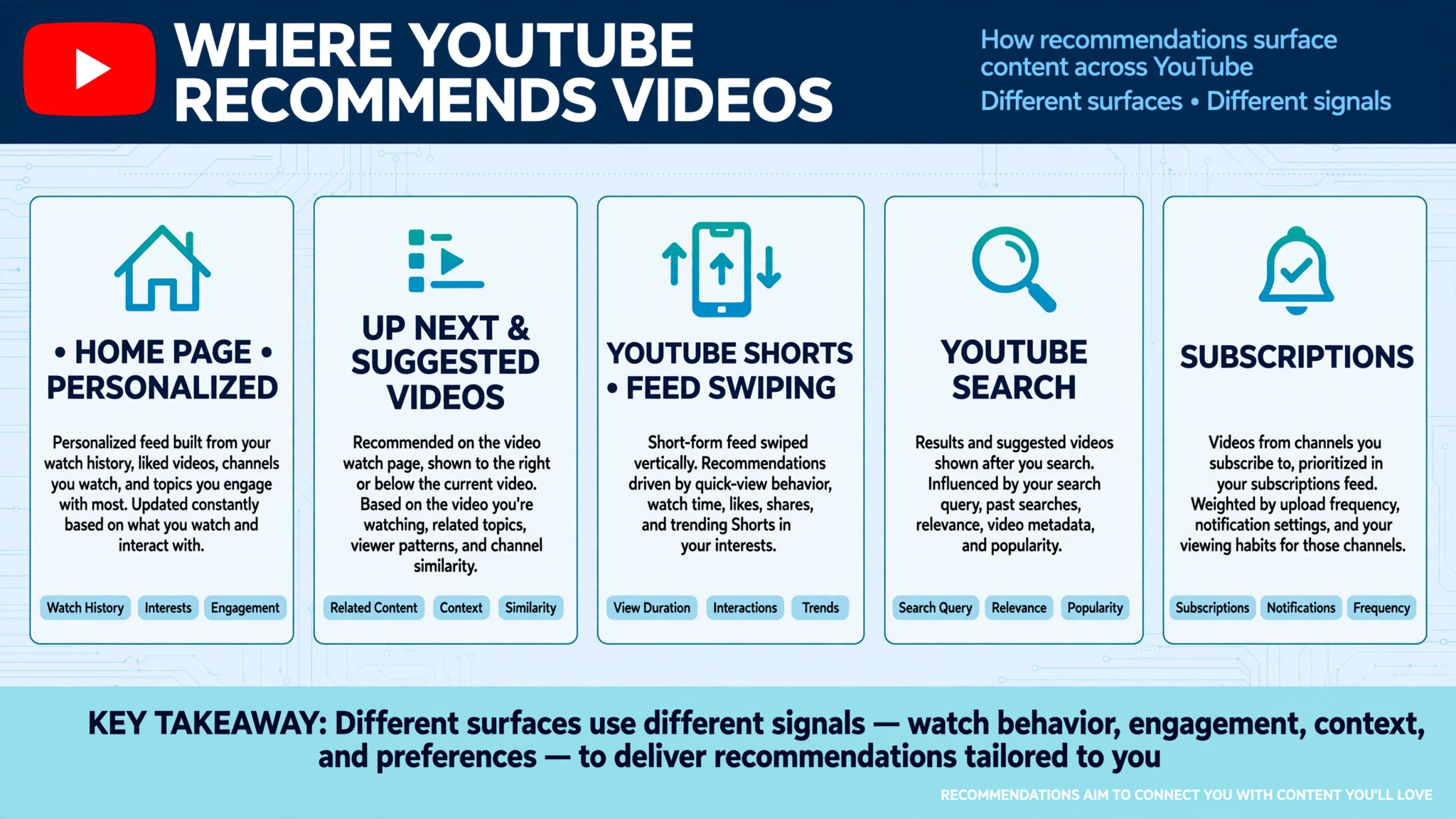
The YouTube algorithm does not recommend videos in just one place. Recommendations appear throughout the platform, and each area serves a slightly different purpose in helping viewers discover content.
YouTube Home
The Home page is one of the main places where personalized recommendations appear. YouTube can show a mixture of videos based on a viewer’s previous activity, interests, and viewing patterns.
This is why two people can open YouTube at the same time and see very different videos on their Home pages.
Up Next and Suggested Videos
When you are already watching a video, YouTube can recommend additional content through the Up Next and suggested-video areas.
These recommendations are often related to the video you are currently watching, but they can also reflect your broader viewing interests. The purpose is to help you discover another video that you may want to watch after the current one.
YouTube Shorts
The Shorts feed provides another recommendation environment. Instead of relying on a traditional list of videos, viewers can continuously swipe through short-form content.
The system can use how viewers respond to individual Shorts to help determine what content may be relevant to them as they continue using the Shorts feed.
YouTube Search
Search works somewhat differently from personalized recommendations. When you enter a query, YouTube needs to identify videos that are relevant to what you searched for.
This means search and recommendations are related but not identical systems. A video appearing in search results does not necessarily mean it will receive the same visibility on the Home page or in Suggested Videos.
Subscriptions and Other Discovery Areas
The Subscriptions section helps viewers find newly published content from channels they have chosen to follow. YouTube also provides other discovery areas across the platform, depending on the type of content and the viewer’s activity.
Together, these different surfaces give YouTube multiple ways to connect viewers with videos.
The important point for creators is that there is no single “YouTube algorithm” controlling every appearance in exactly the same way. Different discovery surfaces can use different signals and serve different purposes, while still working toward the broader goal of helping viewers find content they are interested in.
What Factors Influence YouTube Recommendations?
There is no single factor that determines whether the YouTube algorithm recommends a video. Instead, YouTube’s recommendation systems consider multiple signals to determine which content may be relevant to a particular viewer.
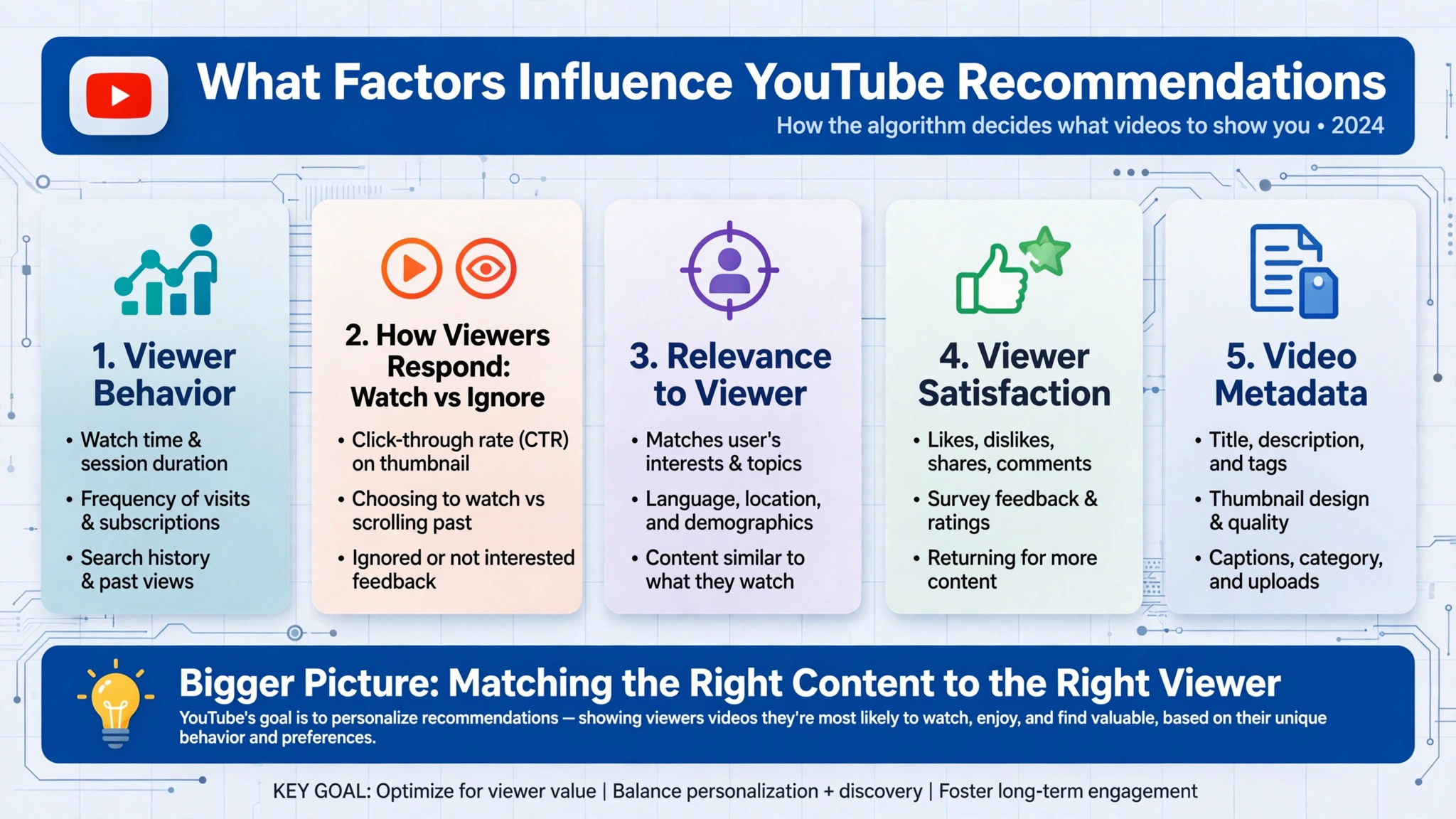
These signals can be broadly understood through four areas: viewer behavior, video performance, relevance, and viewer satisfaction.
YouTube explains that recommendation systems use signals related to viewer personalization and content performance, including how viewers respond to videos. See YouTube’s official explanation of its recommendation system.
1. Viewer Behavior
One of the strongest sources of information comes from the viewer’s own activity on YouTube.
The videos someone watches, the topics they search for, and the content they choose to engage with can help YouTube understand their interests. This type of online behavior is also closely connected to the broader effects of social media on how people consume and interact with content.
For example, if a viewer regularly watches videos about photography, YouTube may have more information suggesting that photography-related content could be relevant to that person.
However, interests are not permanent. If the same viewer begins watching videos about travel or cooking, their recommendations can gradually reflect those changing interests.
2. How Viewers Respond to a Video
What happens after a video is recommended can also provide useful signals.
A viewer might choose to watch the video, ignore it, leave shortly after starting it, or continue watching. These different responses provide information about how well the recommendation matched that particular viewer.
This is why simply getting a video displayed to someone is not the end of the process. The viewer’s response can influence whether similar recommendations are useful in the future.
3. Relevance to the Viewer
A video can perform well overall and still not be relevant to every person.
YouTube therefore needs to consider whether a particular video matches the interests and context of the viewer receiving the recommendation.
For instance, a highly popular video about advanced programming may be successful with software developers but may not be a useful recommendation for someone who has never shown an interest in programming.
The recommendation system is therefore concerned not only with how popular a video is, but also with who is likely to find it relevant.
4. Viewer Satisfaction
Getting someone to click on a video is only one part of creating a successful viewing experience.
YouTube has increasingly emphasized the importance of helping viewers find content they actually value. Signals related to viewer satisfaction can therefore help the system understand whether recommended content was a good match.
This is an important distinction for creators. A video may attract attention with an interesting title or thumbnail, but if the actual content does not meet the viewer’s expectations, that initial click does not necessarily translate into a successful recommendation experience.
5. The Video Itself
The content of a video also provides information that can help YouTube understand what the video is about.
Titles, descriptions, and other information supplied by creators can help provide context about the subject of the video. This makes it easier for YouTube to understand which viewers may be interested in the content.
However, metadata alone does not guarantee recommendations. A well-written title or description cannot compensate for content that viewers consistently find irrelevant or unsatisfying.
Viewer Behavior
What viewers watch, search for, and interact with provides signals about their interests.
Viewer Response
Watching, skipping, or leaving a recommended video can provide information about how well it matched the viewer.
Content Relevance
YouTube considers whether a video is relevant to the interests and context of the viewer.
Viewer Satisfaction
Recommendations are not only about attracting clicks; the system also aims to connect viewers with content they find valuable.
The Bigger Picture
These signals should not be viewed as separate switches that creators can simply turn on or off.
The YouTube recommendation system considers information from both the viewer and the content to determine what may be a useful recommendation.
That is why there is no universal formula such as:
More views = more recommendations
or
Longer videos = better rankings
Instead, recommendation systems are designed to evaluate whether a particular video is a good match for a particular viewer.
The most important question is not simply whether a video performs well, but whether it performs well with viewers who are likely to value that content.
Does Watch Time Still Matter on YouTube?
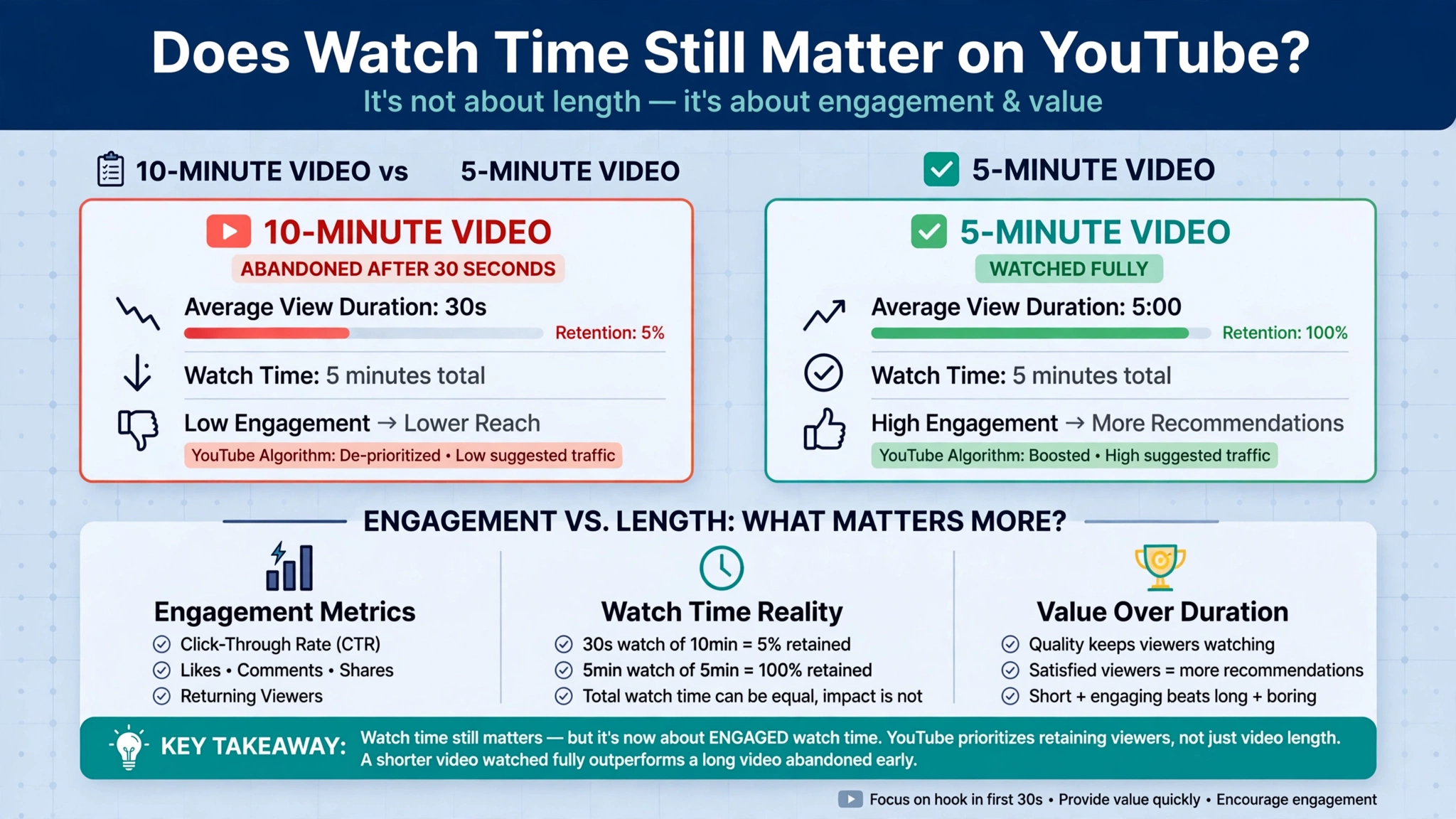
Watch time has played an important role in the history of the YouTube algorithm, but it should not be understood as a simple rule where longer videos automatically receive more recommendations.
However, YouTube states that there is no universal ideal video length. The recommended approach is to make a video as long as necessary to effectively deliver its information or entertainment value. Read YouTube’s guidance on video length and recommendations.
YouTube introduced greater emphasis on watch time in 2012 as a way to move beyond simply counting clicks and views. The idea was straightforward: if viewers spend more time watching a video, that can provide a stronger indication that the content attracted and retained their attention.
However, the length of a video and the amount of watch time it generates are not the same thing.
A ten-minute video that viewers leave after thirty seconds may provide a poorer viewing experience than a five-minute video that viewers watch almost completely. Simply making a video longer does not guarantee that viewers will find it useful or that YouTube will recommend it more widely.
Watch Time Is About Viewer Engagement
For creators, the more useful approach is to focus on whether viewers actually want to continue watching.
A strong opening can help set expectations, while clear and useful content can encourage viewers to remain engaged. If a video consistently loses viewers very early, its length alone will not solve the problem.
This is also why creators should avoid adding unnecessary material simply to increase the duration of a video. The goal should be to provide value for as long as the content deserves, rather than making the video longer just to increase watch time.
What Creators Should Remember
Watch time can be an important part of understanding how viewers interact with content, but it is only one piece of a much larger recommendation system.
A successful video needs to attract the appropriate audience, deliver what the title and thumbnail promise, and provide an experience that viewers find worthwhile.
In other words, don’t ask:
“How can I make this video longer?”
Instead, ask:
“How can I make viewers want to keep watching?”
That change in mindset is much more useful when creating content for YouTube.
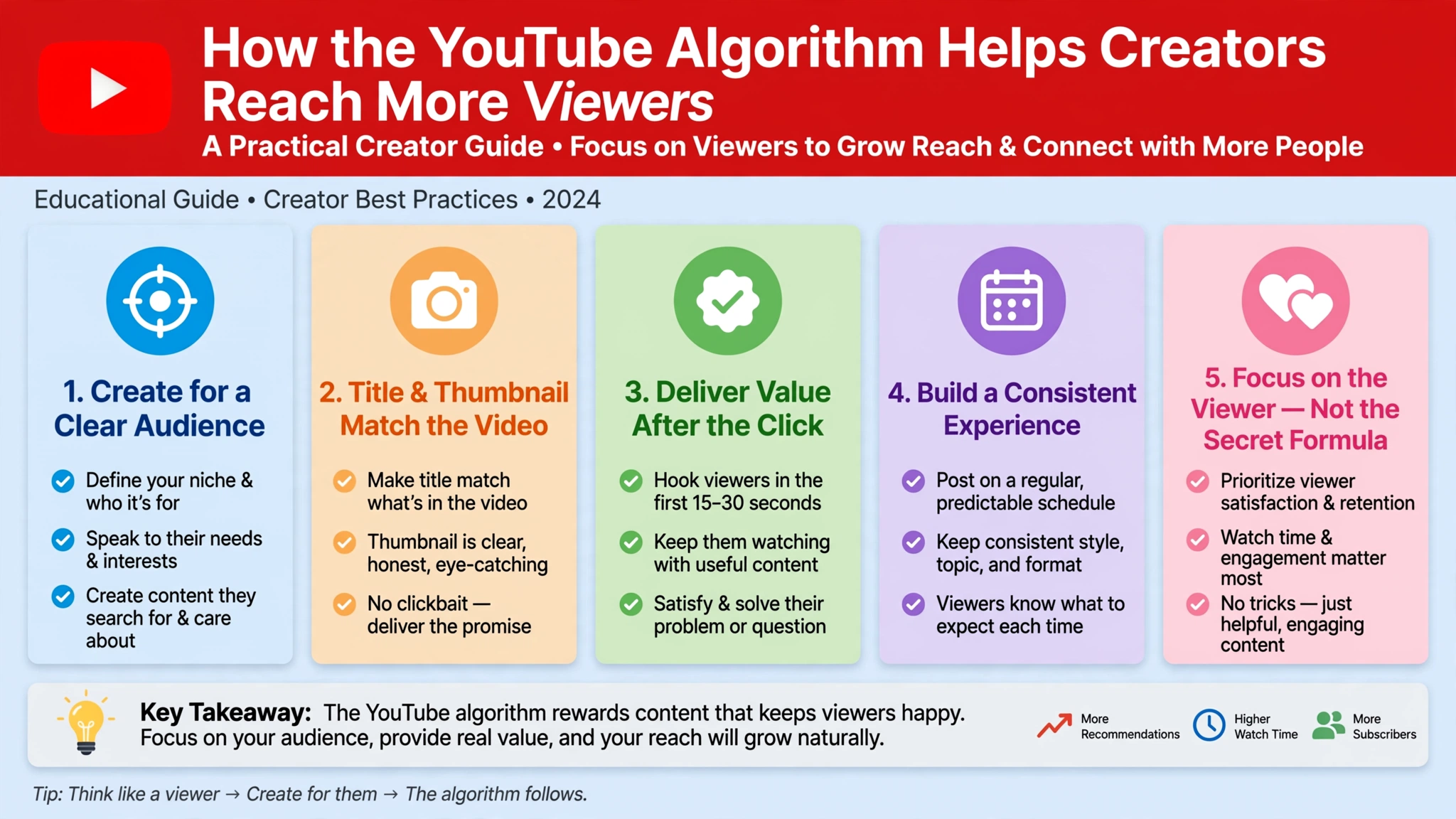
How the YouTube Algorithm Helps Creators Reach More Viewers
Understanding the YouTube algorithm is useful for creators, but the goal should not be to find a secret formula for manipulating recommendations. A better approach is to create content that is relevant to a specific audience and gives viewers a reason to keep watching.
When viewers consistently respond positively to a particular type of content, YouTube has more information that can help it identify other viewers who may also be interested in that content.
Create Content for a Clear Audience
Before worrying about the algorithm, creators should understand who they are making videos for.
A channel that consistently covers a recognizable topic can make it easier for viewers to understand what they can expect from that channel. It can also help creators build an audience with related interests.
This is particularly important for creators and social media influencers who are trying to build a recognizable audience around their content.
For example, a technology channel might focus on smartphone reviews, software tutorials, or computer guides rather than constantly switching between unrelated subjects.
Make the Title and Thumbnail Match the Video
Titles and thumbnails are often the first things viewers see before deciding whether to watch.
An effective title should clearly communicate what the viewer can expect, while the thumbnail should support that message. Creating curiosity is useful, but misleading viewers can create a poor experience when the actual video does not deliver what was promised.
The objective is not simply to get a click. It is to attract the right click from someone who is genuinely interested in the content.
Deliver Value After the Click
Once someone starts watching, the video needs to deliver on its promise.
If the title and thumbnail create one expectation but the opening of the video provides something completely different, viewers may leave quickly. On the other hand, a clear introduction followed by useful or entertaining content can give viewers a reason to continue watching.
This is where the connection between attracting viewers and satisfying viewers becomes important.
Build a Consistent Content Experience
Consistency does not necessarily mean uploading a video every day.
Instead, creators can focus on developing a recognizable content experience. When viewers know what a channel generally provides, they may be more likely to return when new videos are published.
Consistency can involve the topics you cover, the type of audience you serve, the quality of your content, and the expectations you establish with viewers.
Focus on the Viewer, Not a Secret Formula
There are countless theories about how to “beat” or “hack” the YouTube algorithm. However, recommendation systems are too complex to be reduced to one trick that guarantees more views.
A more sustainable approach is to ask:
Who is this video for?
Why would that viewer want to watch it?
Does the video deliver what the title and thumbnail promise?
Would the viewer find the experience valuable enough to continue watching?
When creators focus on these questions, they are addressing the same fundamental challenge that recommendation systems are designed to solve: connecting viewers with content they are likely to appreciate.
YouTube Algorithm: What Matters and What Does Not
There are many assumptions about what makes the YouTube algorithm recommend a video. Some are based on how YouTube has worked in the past, while others oversimplify how its recommendation systems work today.
The easiest way to understand the difference is to compare common creator beliefs with a more accurate way of looking at them.
| Common Belief | What Creators Should Understand |
|---|---|
| More views automatically mean more recommendations. | Views can show that a video attracted attention, but recommendations are also influenced by whether the content is relevant and valuable to the viewers receiving it. |
| Longer videos always perform better. | Video length alone does not guarantee success. A video should be as long as necessary to deliver its value without unnecessary content. |
| More clicks always help a video. | A click is only the beginning. If viewers do not find what they expected after clicking, the recommendation may not provide a good viewing experience. |
| YouTube recommends the same videos to everyone. | Recommendations are personalized, so different viewers can receive different videos based on their interests and activity. |
| Uploading every day guarantees algorithmic success. | Consistent publishing can help creators maintain an active audience, but frequency alone does not guarantee recommendations. |
| There is one secret formula for the algorithm. | YouTube uses recommendation systems that consider multiple signals, making it unrealistic to reduce the entire system to one simple trick. |
| Keywords alone can make a video successful. | Titles, descriptions, and other information help provide context, but metadata alone does not guarantee that viewers will watch or value the content. |
The key lesson is that creators should avoid chasing individual metrics in isolation. A video can receive many clicks, generate substantial watch time, or have an attractive thumbnail, but those numbers do not automatically mean that it is the best recommendation for every viewer.
The stronger approach is to create content for a clearly defined audience, accurately communicate what the video offers, and provide an experience that viewers find worthwhile.

There is no single metric that can explain why every video gets recommended. The YouTube algorithm works by bringing together multiple signals to find content that is relevant to individual viewers.
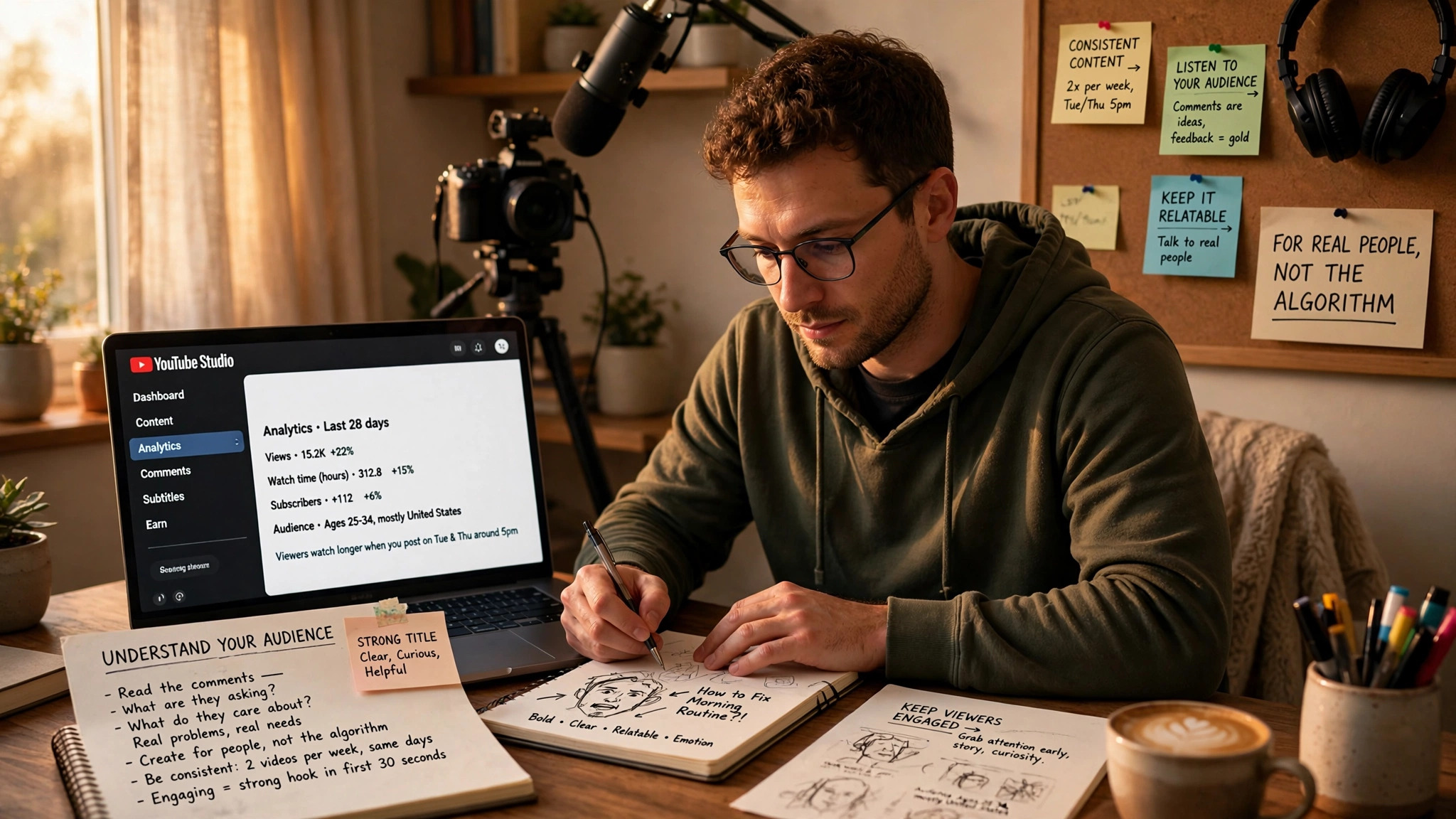
How to Improve Your Chances of Being Recommended
There is no guaranteed method for making the YouTube algorithm recommend a video. However, creators can focus on the elements that contribute to a strong viewing experience and make it easier for the right audience to discover their content.
Understand Your Audience
Identify the people you want to reach and understand their interests, questions, problems, and the type of content they are looking for.
Create a Strong Title and Thumbnail
Clearly communicate what your video offers without misleading viewers. The goal is to attract the right audience and deliver on the promise made by your title and thumbnail.
Keep Viewers Engaged
Give viewers a reason to continue watching. Avoid unnecessary introductions, repetition, and content that does not contribute to the video's purpose.
Be Consistent With Your Content
Develop a sustainable publishing approach that helps viewers understand what your channel is about without sacrificing the quality of your content.
Use Accurate Video Information
Use clear and accurate titles, descriptions, and other video information to help communicate what your content is actually about.
Study How Your Audience Responds
Look for patterns across your videos and learn which topics and formats your audience responds to instead of focusing entirely on one individual metric.
Ultimately, the best approach is not to create content for the algorithm. Create content for people, and use the information available to you to understand whether those people are finding your videos useful, interesting, or entertaining.
The algorithm is constantly changing, but the need to create valuable content for a real audience remains.
Common Myths About the YouTube Algorithm
The YouTube algorithm is often described as if it were a secret formula that creators can unlock to guarantee millions of views. In reality, YouTube’s recommendation systems are much more complex, and many popular claims oversimplify how recommendations work.
Understanding these misconceptions can help creators focus on the things they can actually control.
Myth 1: More Views Always Mean More Recommendations
A video receiving many views does not automatically mean that it will be recommended to every viewer.
Views show that people watched the video, but recommendations also depend on whether the content is relevant to the individual viewer and how viewers respond to it.
Myth 2: Longer Videos Are Always Better
Making a video longer simply to increase watch time is not a reliable strategy.
A video should be long enough to properly cover its subject, but unnecessary material can make the viewing experience worse. The focus should be on keeping viewers interested rather than adding minutes without value.
Myth 3: You Need to Upload Every Day
There is no universal requirement that creators must publish a video every day to succeed.
A sustainable publishing schedule can help a channel remain active, but publishing frequency by itself does not guarantee that videos will be recommended.
Myth 4: Keywords Control the Algorithm
Keywords can help provide context about what a video is about, but they are not a magic switch that makes YouTube recommend content.
Titles and descriptions should accurately describe the video rather than being filled with unrelated keywords simply because those terms are popular.
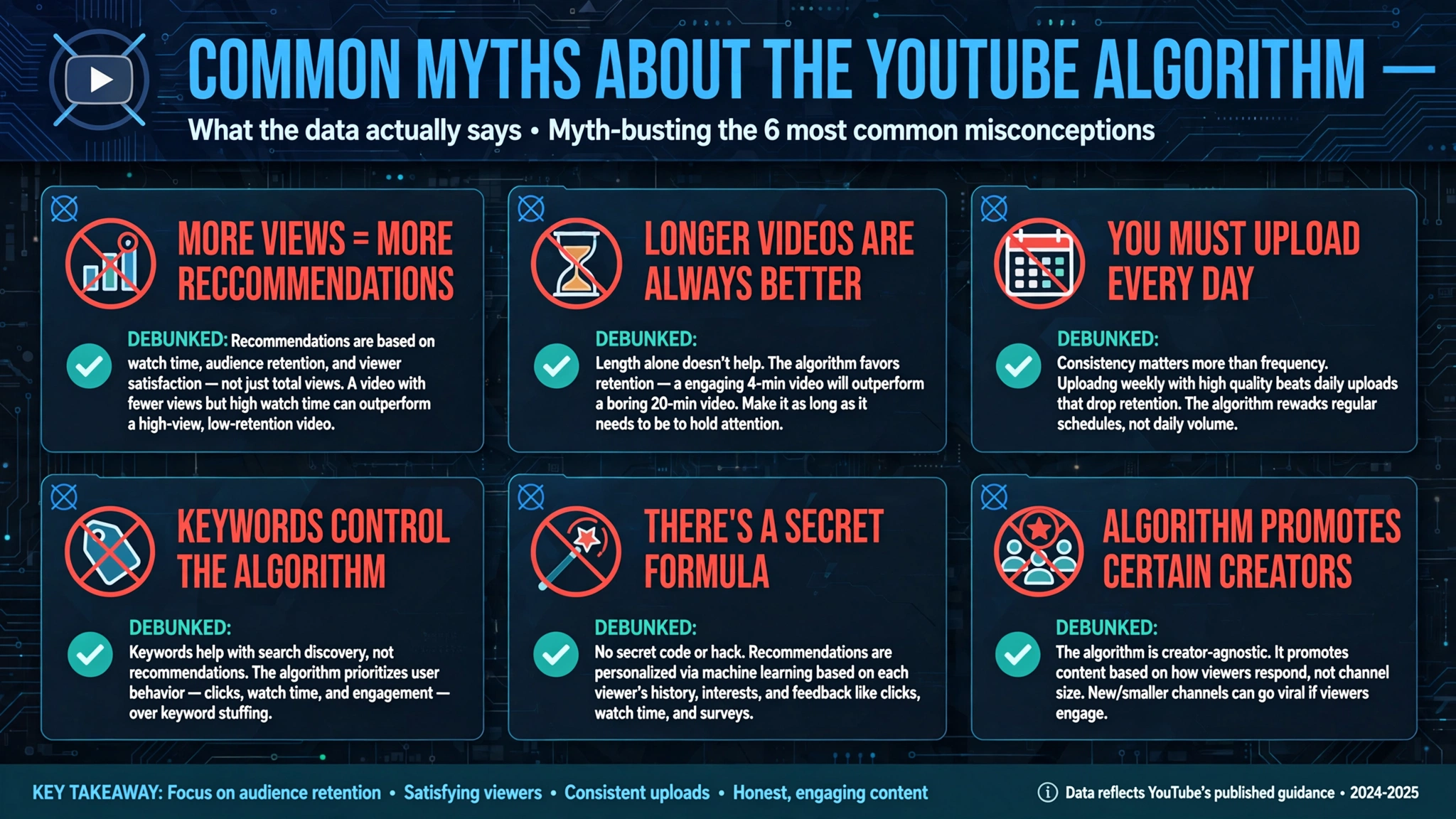
Myth 5: There Is One Secret Algorithm Formula
Perhaps the biggest misconception is that there is one hidden formula that tells creators exactly how to get recommended.
YouTube’s recommendation systems consider multiple signals and personalize recommendations for individual viewers. Because of this, a tactic that works well for one channel or audience may not produce the same result for another.
Myth 6: The Algorithm Is Trying to Promote Certain Creators
The recommendation system is not simply a list of creators that YouTube has decided to promote.
Its purpose is to connect viewers with content that may be relevant and satisfying to them. A smaller channel can therefore reach viewers when its content is a good match for those viewers.
The most useful way to think about the YouTube algorithm is not as an opponent that creators need to defeat, but as a recommendation system that is constantly trying to match viewers with content they are likely to value.
How does the YouTube algorithm work?
The YouTube algorithm uses recommendation systems that consider multiple signals to determine which videos may be relevant to an individual viewer. These can include viewing behavior, viewer responses, content relevance, and satisfaction.
What does the YouTube algorithm look at?
YouTube recommendations can be influenced by signals such as what viewers watch, what they search for, how they respond to videos, and whether recommended content appears relevant and satisfying to them. Information about the video itself can also help YouTube understand its subject.
Does watch time still matter on YouTube?
Watch time remains an important way of understanding how viewers interact with videos, but longer videos are not automatically better. A video should provide value for as long as the content deserves rather than being extended simply to increase watch time.
How can I get my videos recommended by YouTube?
There is no guaranteed formula for getting recommended. Creators can improve their chances by understanding their audience, creating relevant content, using accurate titles and thumbnails, keeping viewers engaged, and studying how their audience responds to their videos.
Does uploading every day help the YouTube algorithm?
Uploading every day does not guarantee that videos will be recommended. A sustainable publishing schedule can help creators maintain an active audience, but content quality, relevance, and viewer response are more important than simply increasing upload frequency.
Do keywords control the YouTube algorithm?
Keywords can help provide context about what a video is about, particularly through titles and descriptions, but they do not guarantee recommendations. Creators should use accurate information rather than filling metadata with unrelated popular keywords.
Does the YouTube algorithm recommend the same videos to everyone?
No. YouTube recommendations are personalized, so different viewers can receive different videos based on their interests, viewing behavior, and responses to content.
Is there a secret formula to beat the YouTube algorithm?
There is no single formula that guarantees success. YouTube uses recommendation systems that consider multiple signals and attempt to connect individual viewers with content they are likely to find relevant and satisfying.
Final Thoughts
The YouTube algorithm has come a long way from the early days when clicks and views were the primary indicators of a video’s popularity. Over time, YouTube has developed increasingly sophisticated recommendation systems that can personalize content for individual viewers.
Today, there is no single metric, shortcut, or secret formula that guarantees a video will be recommended. Viewer behavior, content relevance, engagement, and satisfaction all contribute to the complex process of connecting people with videos they may want to watch.
For creators, the most sustainable approach is to understand their audience, create content that delivers genuine value, and make sure the title and thumbnail accurately represent what the video provides.
Instead of trying to beat the YouTube algorithm, focus on creating videos that give the right viewers a reason to click, watch, and come back.
When you create for people first, the algorithm has a better opportunity to understand who may benefit from your content.



0 Comments